
Bedroom Shutters
Transform your bedroom with made-to-measure plantation shutters. Designed to block light, reduce noise and improve insulation, our bedroom shutters create the perfect sleep environment. Choose from hardwood or faux wood, in a range of styles and finishes. Save up to 60% with DIY installation.
Transform your bedroom with made-to-measure plantation shutters. Designed to block light, reduce noise and improve insulation, our bedroom shutters cr...

Add measurements to see prices for your own window. How to measure.
FAQs about Shutters for Bedrooms
Bedroom shutters are an excellent choice for light control. While no shutter blind is 100% "blackout" due to the nature of moving louvres, a full-height design provides exceptional light reduction. For a total darkness solution, these can be paired with blackout curtains, or some customers like to install blackout blinds behind their shutters.
Yes, bedroom window shutters act as a robust barrier against both temperature and external noise. By installing DIY shutters, you create an insulating layer of air between the glass and your room, which is a major pain point for those in drafty homes. This helps keep the space warmer in winter and cooler in summer. The solid structure offers significantly better sound dampening than traditional thin fabric curtains.
Our bedroom shutters start from as little as £182 per square metre, making them significantly more affordable than professionally installed alternatives, typically saving you 60%. Read our guide on how much DIY shutters cost for more info.
Bedroom shutters are available in both our hardwood and faux wood shutter materials. Hardwood shutters are the most popular option because of the classic aesthetic and insulating properties. However, if you’re worried about condensation in your bedroom, which can lead to moisture buildups, faux wood shutters offer a waterproof solution.
Related articles
Related articles
Why Choose Made-to-Measure Bedroom Shutters?
Why should I choose a Tier on Tier shutter?
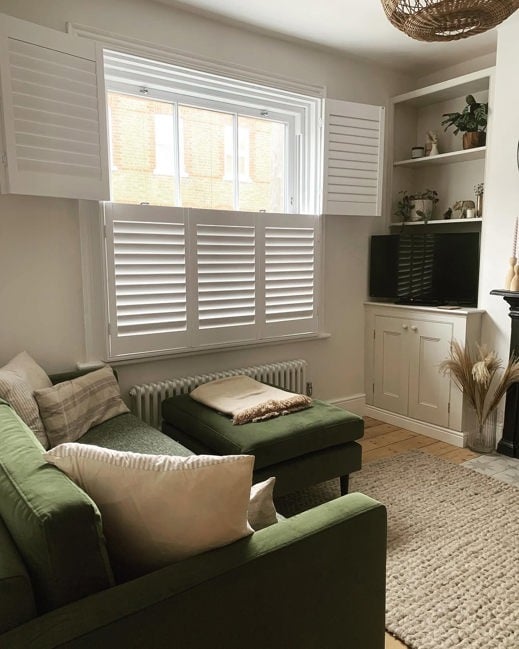
Tier on tier shutters are designed to let you open the top shutter panels independently from the lower panels. These are a great choice if you are concerned about privacy but still want to allow maximum light into your room.
Tier on tier shutters work well if you are going to open the top panels on a regular basis. If you are likely to leave the top panels closed, a better option might be full height shutters.
Will Tier on Tier work well on my window?
The size and shape of your window is key to determining if Tier on Tier will be a suitable design for your window. Tier on tier works well on tall windows. The window must be taller than it is wide for the panels to be properly supported. An example of a window that works well with this design is a sash window. If your window is wider than it is tall, a full height shutter may be a more appropriate design.
How many panels should I choose?
The first factor to consider when choosing the number of panels is the design of the window. For example, if the window is divided into three even sections, you could opt for three panels on each tier of your shutter.
It is best to select narrow width panels that fold onto each other in a tier on tier design, as the top panels will be open frequently. This means selecting a higher number of panels.
Where should I put my Tier on Tier divide point?
The location of your divide point will be dictated by the design of your window. There is often a divide in the window, such as a transom or meeting rails on a sash window shutters. It is best to align the shutters' divide point with this divide in the window.
It is best for the design if the divide point is fairly close to the middle of the shutter. If you need to place the divide point quite high up the shutter and have a small top panel, you may instead want to go for a full height shutter.
Here at DIY Shutters, our Tier on tier shutters feature a T-Bar. When measuring for the divide point, you are measuring to the centre of where you want the T-Bar to go. This will be from the bottom of the shutter to the centre of the transom or rail in the window.
What is a T-Bar?
A T-Bar is a piece of horizontal frame that will sit between the top and bottom panels. It provides the top panels a frame side to rest upon when closed. It is important to note that the T-Bar is fixed and cannot be removed.
What if my window is too wide for one shutter?
If your window is larger than the maximum limitation for shutters, we instead advise opting for a Full Height shutter. You can split up the window to have multiple shutter frames.